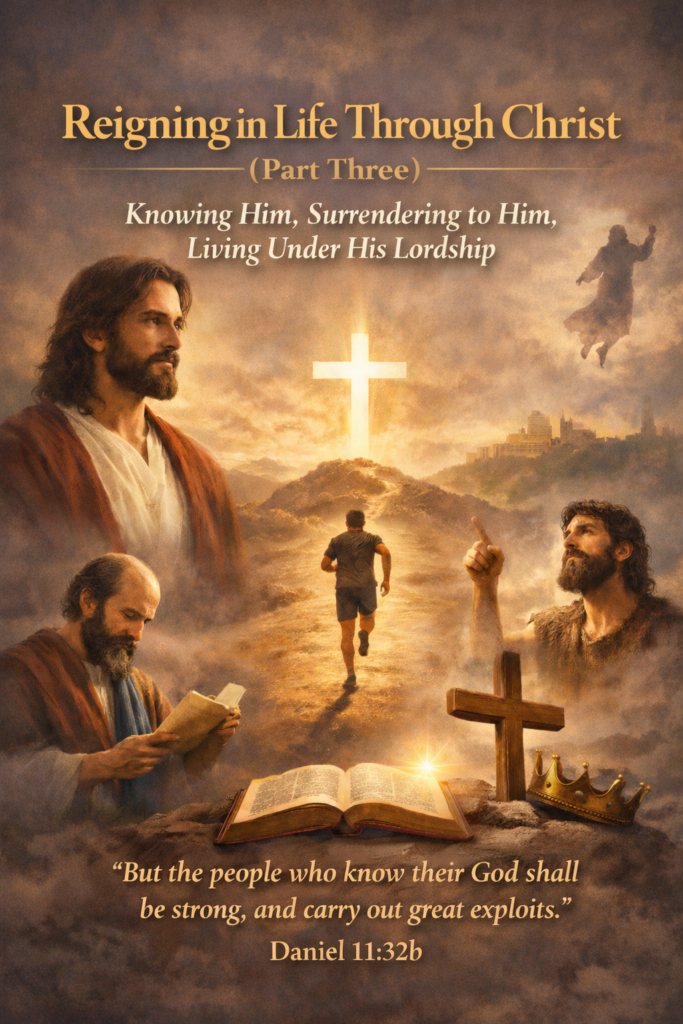
Reigning in Life Through Christ pt. 3
By Pastor Chinedu Emmanuel
Daniel 11: 32b “But the people who know their God shall be strong and do exploits.”
Reigning in life does not happen by accident. It is the outcome of a life that has come to the end of itself and has fully yielded to God. In this third part of our teaching on reigning through the Lord, we are reminded of a central truth: the rule of the Christian race is to run to please the Lord. Not to please self. Not to impress people. Not to gain titles or validation, but to do His will. The Bible says, “The people who know their God shall be strong and carry out great exploits” (Daniel 11:32b). Strength and victory flow from knowing God, not from human effort.
In Part Two, we learned that reigning in life flows from intentional alignment with God. The Christian life is a race, and the most important rule of that race is living to please the Lord. As believers, we were reminded to guard our hearts against distractions, walk by the Spirit rather than the flesh, and allow Christ, who is the wisdom of God, to shape our understanding of God’s will. Knowing Him produces focus, obedience, and spiritual stability. We run this race by looking unto Jesus. The Bible says we are to look to Him as the author and finisher of our faith (Hebrews 12:2). We learn from Him. We allow His Spirit to teach us. And as we do, our lives begin to align with God’s purpose.
Jesus Lived as a Man and Became Our Example
Jesus did not live on earth as a spirit pretending to be human. The Bible says He laid aside His divine privileges and took on the form of a servant (Philippians 2:6 to 7). He lived a genuine human life. He experienced temptation, rejection, misunderstanding, family pressure, and pain, yet He did not sin (Hebrews 4:15). Jesus lived as a man; He qualifies to be our perfect example. He understands human weakness, yet He shows us how to live in victory. Though He was God, He chose dependence. He said plainly, “The Son can do nothing of Himself” (John 5:19). His strength flowed from total submission to the Father.
My Food Is to Do the Will of Him Who Sent Me
Jesus revealed the driving force of His life when He said, “My food is to do the will of Him who sent Me and to finish His work” (John 4:34). His sustenance, identity, and purpose were rooted in obedience. He did not live to fulfill personal ambition or seek human approval. He listened to the Father, received instruction, and acted only according to God’s will. That posture of surrender pleased God. Jesus willingly surrendered His life; the Father found in Him a worthy Lamb. He was not forced. He was not compelled. The Bible says He laid down His life willingly (John 10:17 to 18). Love, by nature, expresses itself through sacrifice.
Knowing God Produces Surrender
Jesus knew the greatness of the Father. He knew that God was greater than all (John 14:28). Because He knew this, surrender was not a struggle. It was a response. True knowledge of God removes pride. When a person knows God by revelation and not by title or activity, self-confidence collapses and surrender becomes inevitable. Jesus understood that as a man, He was insufficient on His own. That awareness did not weaken Him. It positioned Him to walk in power.
Walking With God Comes From Knowing God
The Bible says Enoch walked with God and pleased Him (Hebrews 11:5). His life teaches us that walking with God is the fruit of knowing God. Walking with God is not achieved by church attendance, religious language, Bible quoting, or ministry titles. It flows from relationship. You cannot walk with someone you do not know. Jesus rebuked those who claimed to know God but did not keep His word (John 8:54 to 55). Knowing God always produces obedience.
Revelation Brings Humility
John the Baptist shows us what happens when Jesus is truly revealed. When Christ was revealed to him, his response was humility. The Bible records his words: “I am not worthy to untie His sandal” (John 1:27) and “He must increase, but I must decrease” (John 3:30). When Jesus is revealed, pride dies. Self importance fades. The hunger for recognition disappears. A person who knows Him steps aside willingly and allows Christ to take His rightful place.
Knowing Jesus Ends Self-Righteousness
The apostle Paul echoes this truth. After encountering Christ, everything he once valued, including status, heritage, achievement, and religious performance, became worthless compared to knowing Jesus (Philippians 3:7 to 10). True knowledge of Christ brings a person to the end of self effort and self trust. It produces surrender and dethrones the ego. God does not primarily use ability, status, or strength. The greatest strength in the kingdom of God is not what we possess, but what we are willing to lay down. Jesus illustrated this when He took five loaves and two fish. In human terms, it was not enough. But once surrendered into His hands, it became more than enough (John 6:9 to 13). Jesus Himself said, “I can do nothing of Myself” (John 5:30). If the Son of God lived that way, how much more must we?
The Power of Humility
The Bible says God resists the proud but gives grace to the humble (James 4:6). Humility is not self hatred. It is clarity. It is recognizing that apart from God, we are insufficient. A humble person no longer chases validation or human honor. Jesus said, “I do not receive honor from men” (John 5:41), explaining that seeking approval from people weakens faith. Many believers focus on fighting the enemy, yet neglect the most important battle, the battle against self. When self is surrendered, the enemy loses access. Reigning in life is not about striving harder. It begins when we stop trusting ourselves and place everything fully in God’s hands. The kingdom advances through surrendered vessels.
That is how Jesus ran His race.
That is how Enoch walked with God.
That is how John the Baptist decreased.
That is how Paul lived.
And that is how we reign, through knowing Him, yielding to Him, and living under His Lordship.
Pastor Chinedu Emmanuel is the Senior Pastor of Fountain of The Living Word Church East Orange, New Jersey.