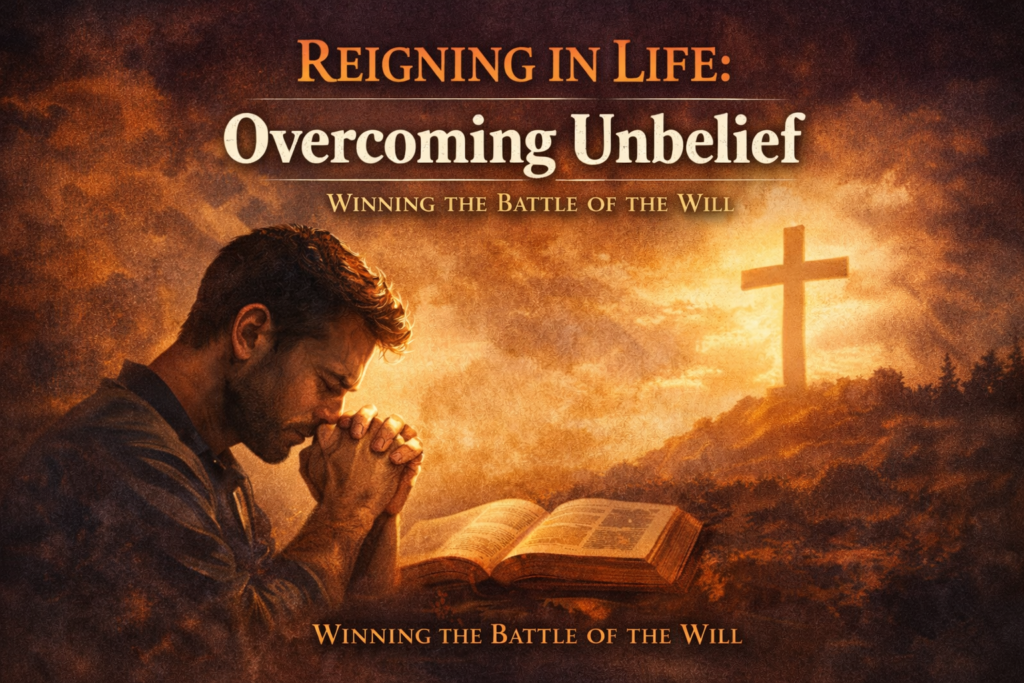
Reigning in Life: Overcoming Unbelief
By Pastor Chinedu Emmanue
“But the people who know their God shall be strong and do exploits.”
— Daniel 11:32b
Reigning in life through Christ does not happen by accident. It is the result of a life that has moved beyond routine religious activity into authentic relationship with God. Scripture makes it clear that God’s desire is not for believers to merely survive spiritually through habits and rituals, but to live in strength, authority, and intimacy with Him.
Last week, we explored what it truly means to know God, not intellectually, not through tradition, but through daily, lived relationship. Knowing God is never passive. It always calls for movement, response, and obedience. Relationship with Him is not measured by familiarity, but by surrender. That truth naturally leads to a deeper question:
If we know what God is asking of us, why do we still resist doing it? To answer that, we must confront something Scripture repeatedly warns about — unbelief.
Beyond the Ritual
Many believers faithfully attend church, pray, and read Scripture, yet still struggle to experience transformation. This is often because ritual can exist without surrender. Outward faith practices can continue while inward resistance remains untouched. We often focus on external opposition when discussing spiritual struggles. It is easy to blame circumstances, spiritual attacks, or difficult environments. While spiritual warfare is real, Scripture consistently draws our attention to a deeper battleground: the human will. The greatest resistance to God’s leading is often not outside us, but within us. If you have ever known exactly what God wanted you to do and still chose to do otherwise, you have encountered unbelief.
Unbelief vs. Doubt: A Critical Distinction
Many believers carry guilt because they experience doubt. However, doubt and unbelief are not the same. Doubt is uncertainty. It asks questions. It wrestles with clarity. Doubt says, “I’m not sure if this is God’s voice.” Unbelief is different. It is a conscious resistance to what God has already made clear. It says, “I know what God said, but I am choosing not to follow it.”
Unbelief is often subtle. It disguises itself as logic, personal justification, or emotional reasoning. It selectively obeys Scripture, embracing what feels comfortable while resisting what feels costly. Over time, this pattern hardens the heart. What once felt like conviction becomes easier to ignore. The voice of the Holy Spirit becomes quieter, not because He has stopped speaking, but because the heart has grown accustomed to resisting Him.
The “Involuntary” Myth
Many people describe sin as something that simply happens to them, as though it occurs automatically. But both Scripture and everyday experience reveal that our actions are connected to our will. Consider something as simple as your hand. Your hand does not reach out and take something on its own. It does not strike someone, type words, or make choices independently. Unless there is a neurological disorder, the hand only moves because the will instructs it to move. The action may feel impulsive, but it is never completely involuntary.
In the same way, sin is not something we simply fall into. It is chosen. And obedience is not something that happens automatically. It must also be chosen. Before Christ, Scripture describes humanity as slaves to sin. That does not mean people were neutral; it means they lacked the internal power to consistently choose righteousness. Obedience was not simply difficult; it was impossible without transformation. But through Christ, that reality changes. Believers are no longer powerless. The struggle is no longer about ability. The struggle is about alignment. The question shifts from Can I obey? to Will I obey?
The Holy Spirit and the Renewal of the Will
This is where hope enters the story. The Holy Spirit’s work is not limited to dramatic spiritual moments or outward displays of power. His primary work is internal transformation. He reshapes the will. Philippians 2:13 tells us that God works in us both to will and to do His good pleasure. God does two powerful things within the believer:
- First, He transforms desire. He plants new longings where resistance once lived.
- Second, He provides strength. He gives the ability to carry out what obedience requires.
This is the renewal of the mind. It is the gradual retraining of our thinking, desires, and decision-making patterns. We begin moving away from a life driven by self-will, which always leads toward brokenness, into a life shaped by surrender, which leads toward peace, clarity, and spiritual authority. Transformation is not behavior modification. It is internal renovation.
How to Defeat the Lion of Unbelief
Moving from ritualistic religion into a genuine walk with God requires intentional shifts.
- Acknowledge God in the Small Things: Many people only seek God during major life decisions or crises. But intimacy with God is built through daily, consistent conversation. Invite Him into ordinary choices such as how to respond in conversations, how to manage frustration, and how to structure your day. Acknowledging God in small moments trains the heart to recognize His voice in larger moments.
- Stop Rationalizing: When Scripture speaks clearly, the human instinct is often to negotiate. We explain, justify, or delay obedience. Rationalization may sound thoughtful, but it often disguises resistance. Obedience rarely requires full understanding. It requires trust. Delayed obedience is still disobedience.
- Become Childlike: Jesus taught that entering the Kingdom requires becoming like a child. Childlike faith is not ignorance. It is dependence. Children trust because they believe they are loved and protected. God does not call believers to intellectual superiority. He calls them to relational trust.
The Blessing of Obedience
Many believers pursue spiritual blessings through knowledge alone. But Scripture repeatedly shows that blessing follows obedience, not information. Knowing the truth is powerful. Living truth is transformational. When faith produces obedience, blessing becomes a natural byproduct rather than something we chase.
Reflect
- Where have I labeled something as doubt when it is actually resistance?
• Is there an area where I know God’s direction but have delayed obedience?
• Are there Scriptures I tend to explain away rather than submit to?
• Have I blamed external pressures for struggles that may actually be internal battles of the will?
Take time to sit honestly before God. Transformation begins where honesty meets surrender.
Respond
- Identify one area, small or significant, where you will practice immediate obedience this week.
• Invite God into everyday decisions, not just spiritual moments.
• When Scripture challenges you, choose trust instead of negotiation.
• Pray this simple prayer:
“Holy Spirit, shape my will to desire what You desire. Teach me to obey quickly and trust deeply.”
Reigning in life through Christ is not built through ritual alone. It is formed through daily surrender. It is cultivated through obedience that flows from relationship. When faith moves from knowing to obeying, Christianity becomes more than belief. It becomes life.
Pastor Chinedu Emmanuel is the Senior Pastor of Fountain of the Living Word Church in East Orange, New Jersey.