Fasting God’s Way
By Pastor Chinedu Emmanuel
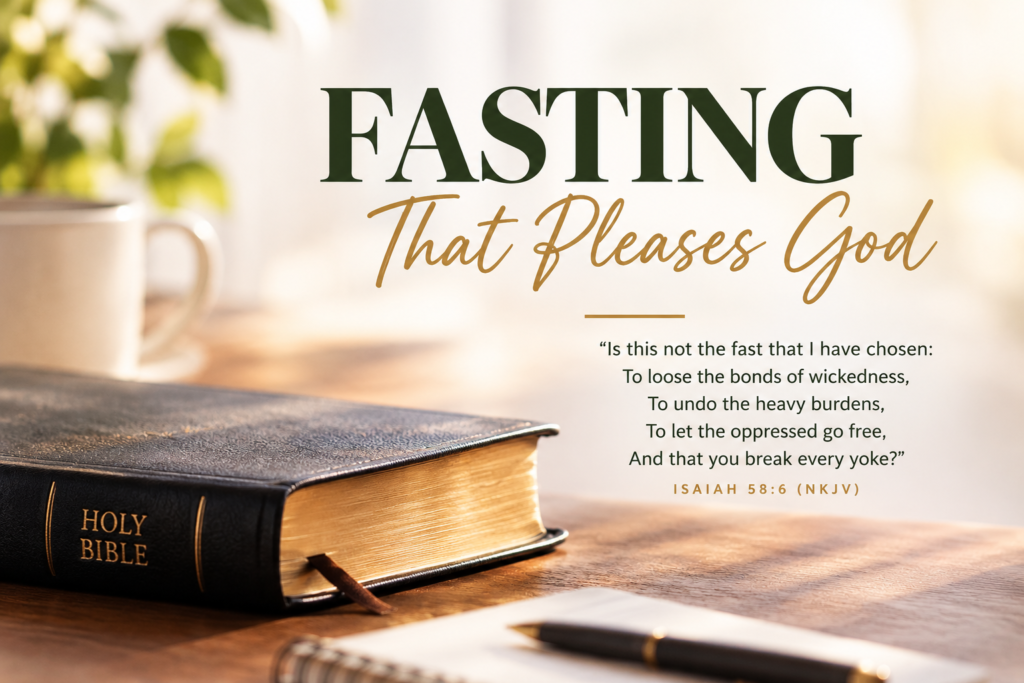
Isaiah 58:6 “Is not this the kind of fasting I have chosen:to loose the chains of injustice and untie the cords of the yoke, to set the oppressed free and break every yoke?
When engaging in spiritual disciplines such as prayer, Bible study, and fasting, our motives and heart posture are of great importance. These practices should not be merely outward expressions of devotion; rather, they should draw us closer to God, deepen our understanding of His Word, and align our lives with His will.
The Foundation: The Word of God
Every spiritual discipline should be grounded in Scripture. When reading the Bible, we should approach the Scriptures with reverence, recognizing them as God’s Word and allowing His truth to shape our beliefs, decisions, and actions.
Throughout His earthly ministry, Jesus consistently directed people to Scripture. In Luke 10:26, He asked, “What is written in the law? What is your reading of it?” Following His resurrection, Jesus opened His disciples’ understanding so they could comprehend the Scriptures (Luke 24:44–45). Faith develops through hearing the Word of God (Romans 10:17). Similarly, Proverbs 4:20–22 instructs us to pay attention to God’s words, meditate on them, and keep them in our hearts. As we study, reflect on, and apply the Word of God, our faith is strengthened, and our lives are transformed.
Understanding the Purpose of Fasting
Fasting is not a means of manipulating God, compelling Him to act, or earning His approval. Rather, fasting provides an opportunity to seek Him intentionally, humble ourselves before Him, and align our hearts with His will. We are justified through faith in Jesus Christ, not through our spiritual efforts or abstinence from food (Galatians 2:16; Ephesians 2:8–9).
The Bibleidentifies several pitfalls to avoid when fasting:
- Fasting for recognition: In Matthew 6:16–18, Jesus cautions against fasting to gain the approval of others. Our devotion should be sincere and directed toward God rather than motivated by a desire for human recognition.
- Fasting with wrong motives: In Isaiah 58, God rebukes the Israelites because they continue to exploit workers, engage in conflict, and oppress others despite their fasting.
- Fasting without genuine heart change: In Zechariah 7:5–10, God challenges the people to examine the purpose of their fasting. The passage emphasizes the importance of practicing justice, showing mercy, and caring for others rather than relying on religious observances alone.
These passages demonstrate that outward religious practices cannot replace genuine obedience or a heart that reflects God’s character.
The Heart Posture of an Acceptable Fast
A fast that honors God involves more than abstaining from food. It requires a sincere heart and a willingness to respond to His Word. Several spiritual attitudes are particularly important:
- Self-examination and repentance: Invite God to examine your heart and reveal areas that require correction (Psalm 139:23–24). Be willing to address pride, bitterness, disobedience, and unhealthy attitudes.
- Humility: Fasting can serve as an expression of dependence on God and recognition of our need for Him. Scripture teaches that God resists the proud but gives grace to the humble (James 4:6; Ezra 8:21).
- Earnest supplication: Approach God sincerely, with a genuine desire to seek Him wholeheartedly (Daniel 9:3).
- Consecration: Set aside intentional time to seek God and His direction. In Acts 13:2–3, the believers ministered to the Lord and fasted before receiving direction from the Holy Spirit.
- Love and service to others: Isaiah 58 describes the fast God desires as one that breaks the yoke of oppression, provides food for the hungry, offers shelter to those in need, clothes the poor, and rejects malicious speech. Genuine devotion should be reflected in how we treat others.
Isaiah 58:8 declares, “Then your light shall break forth like the morning.” This promise appears within a broader passage that connects an acceptable fast with righteousness, compassion, and obedience. The emphasis is not merely on abstaining from food but also on living in a manner that reflects God’s character.
Different Forms of Fasting
Scripture provides examples of different approaches to fasting:
- Absolute fast: Abstaining from both food and water for a specified period, as illustrated in Esther 4:16.
- Normal fast: Abstaining from food while continuing to drink liquids.
- Partial fast: Restricting certain foods or following a simplified diet, as illustrated in Daniel 1:12 and Daniel 10:2–3.
Although the form of fasting may vary, the purpose should remain consistent: to seek God sincerely and intentionally. Any fast involving abstinence from water requires particular caution because of the risk of dehydration.
Conclusion
Whether undertaking an absolute, normal, or partial fast, it is important to recognize that the physical act of abstaining from food is not the ultimate goal. Rather, fasting should be accompanied by a humble heart, a commitment to God’s Word, and a willingness to obey Him. As you fast, set aside time to meditate on Scripture, examine your motives, seek God’s direction, and allow Him to transform your character. Let your devotion extend beyond prayer and abstinence to include practical expressions of love, justice, mercy, and service. Ultimately, the heart of an acceptable fast is not simply what we give up for God, but how we draw near to Him and allow His Word to shape the way we live.
Pastor Chinedu Emmanuel is the Senior Pastor of Fountain of the Living Word Church, East Orange, New Jersey.