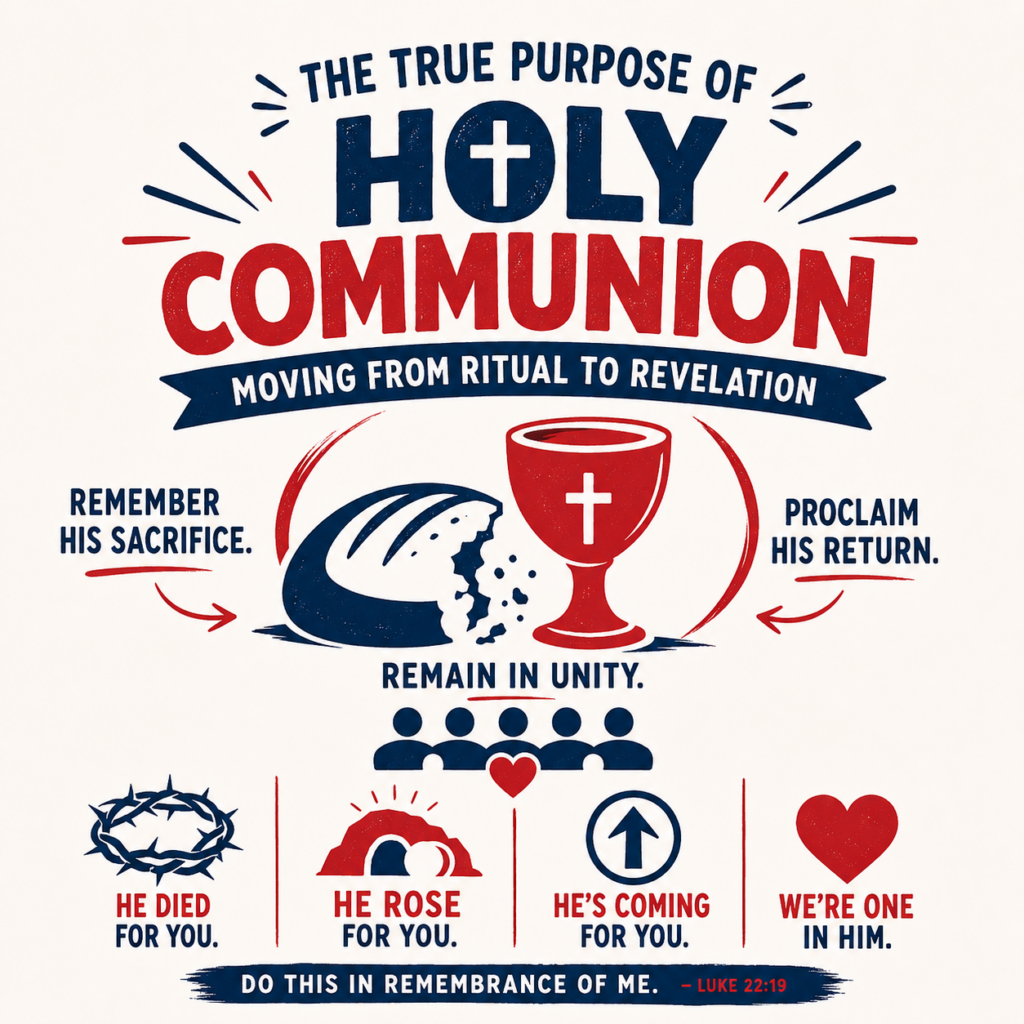
Holy Communion: More Than a Ritual
By Pastor Chinedu Emmanuel
1 Corinthians 11:23-25 “For I have received of the Lord that which also I declared unto you, That the Lord Jesus the same night in which he was betrayed took bread: And when he had given thanks, he brake it, and said, Take, eat: this is my body, which is broken for you: this do in remembrance of me. After the same manner also he took the cup, when he had supped, saying, This cup is the new testament in my blood: this do ye, as oft as you drink it, in remembrance of me.”
Have you ever sat through a church service, received Holy Communion, and felt like you were just going through the motions? It’s easy to drift naturally into religion and routine. Human beings forget easily, which is exactly why Jesus instituted the Holy Communion: not as a repetitive church ritual, but for a distinct purpose that strengthens our faith and keeps us aware of the life-saving work of the cross. When we understand the scripture behind the communion, we align our faith with God’s power. But when we operate in ignorance, we face the dangerous spiritual consequences of treating a sacred covenant like a thoughtless habit.
Covenant Feast of Commemoration
At its core, the Holy Communion is a covenant feast. A commemoration is simply the remembrance of a monumental event. In this case, it is a reminder of our covenant with God through the blood of Jesus Christ, marking the moment we were restored to peace and saved from the consequences of sin. In ancient Eastern cultures, and even in many cultures today, entering into a serious covenant always required a feast. When Jacob and Laban made a peace treaty, they piled stones as a reminder and sat down to eat a covenant meal. Similarly, Jesus used bread and wine because bread was the foundational, everyday food of the time.
Breaking Down the Metaphors: Bread and Wine
The Bible relies heavily on symbols and metaphors to explain spiritual realities we cannot see with our natural eyes.
The Broken Body (The Bread): When Jesus said, “This is my body,” He was speaking metaphorically, just like when He called Himself the “vine”. The breaking of the bread represents His physical suffering and crucifixion. Through His broken body, sin completely lost its power over our lives. Freedom from sin doesn’t happen because of our human willpower or by following “seven religious steps” to self-improvement; it happened strictly when Christ died on the cross. When we died with Him, we were set free; when He rose, we were raised into a brand new life.
The Shed Blood (The Cup): The cup represents the New Covenant ratified by Jesus’ blood. In Leviticus 17:11, God told Israel that the life of the flesh is in the blood, and that blood on the altar was meant to make atonement for souls. Jesus took His own blood to the ultimate, real altar, the one in heaven, not made with human hands, and obtained an eternal redemption for us. Because the price was paid in full, you are now completely justified to receive heaven’s blessings. Think of it like a store receipt: you don’t have to beg the cashier for the item if it has already been paid for.
Remembering His Return and Remaining in Unity
The Holy Communion is also an urgent reminder of a future event: the second coming of Christ. Modern church culture often stays hyper-focused on earthly prosperity, career breakthroughs, and material success. But the early church didn’t preach as though they only lived here; they lived with their affections set on heaven, eagerly and actively preparing for Jesus to stand at the door. In fact, the Apostle Paul routinely mentioned Christ’s return about 50 times across his letters. Every time you take communion, it flashes a spiritual signal: He is coming back.
Beyond looking upward, communion requires looking outward. The unity of the church is paramount to God’s plan. In 1 Corinthians 10:17, Paul states that we, though many, are one bread and one body. This is a beautiful metaphor: just as many loose grains of wheat are kneaded together to form a single loaf of bread, we are baptized by one Spirit into one unified body. The word communion implies joint sharing in the family of God. Because we are one body, individual members cannot isolate themselves or cause division without hurting the whole.
The Serious Danger of Division
If a church or a family is divided, the Holy Spirit will not function at maximum capacity. The devil explicitly uses division to block the moves of God. Jesus stated clearly that a house divided against itself cannot stand. The Apostle Paul wrote his strict warnings about communion to the Corinthian church precisely because they were plagued by division and class distinctions. During their love feasts, the wealthy hurried to eat their own lavish food, leaving the poor hungry, while others got drunk. They were failing to discern the oneness of the Lord’s body.
The spiritual stakes are incredibly high. Scripture warns that those who eat and drink unworthily drink damnation to themselves, which is why many in Corinth became weak, sickly, and died prematurely. God takes the destruction of His temple personally; 1 Corinthians 3:17 warns, “God will destroy anyone who destroys this temple.” When you gossip, harbor bitterness, or poison the minds of others, you are tearing down the doors and windows of God’s house.
A Call for Self-Reflection
Similar to fasting, the Holy Communion requires deep, honest self-reflection. If you know there is bitterness, ego, or unresolved conflict in your life, you are taking a catastrophic risk by remaining silent.
In marriage: If you and your spouse have bitterness against each other, go home and sort it out. Be “the fool,” swallow your pride, and say “I’m sorry” so your spiritual unity can be restored.
In the church: Stop participating in gossip or groupism. Avoid people who use smooth talk and fast speeches to sow division.
The time of ignorance is over; now you know the truth. Let us stop scattering what Jesus is trying to build, lay down our anger, and watch the Holy Spirit transform our lives.
Pastor Chinedu Emmanuel is the Senior Pastor of Fountain of the Living Word Church in East Orange, New Jersey.