Reclaiming True Worship
By Pastor Chinedu Emmanuel
Romans 12:1 “I appeal to you therefore, brothers, by the mercies of God, to present your bodies as a living sacrifice, holy and acceptable to God, which is your spiritual worship.”
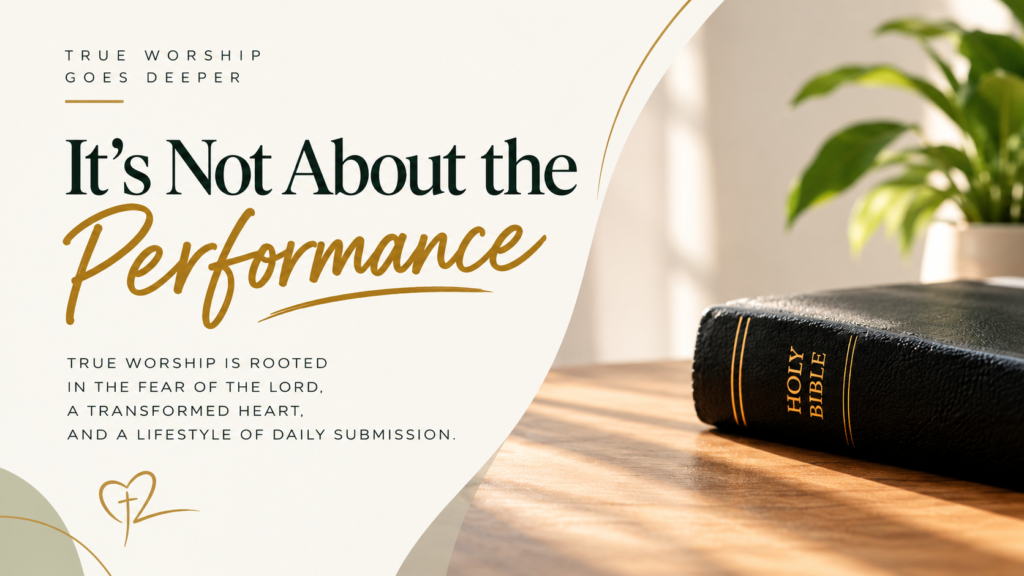
It is easy to equate worship with atmospheric music, emotional singing, and animated outward expressions. We raise our hands, sing familiar hymns, and assume that because we are engaging in religious tradition, God is automatically pleased. However, Scripture presents a sobering counter-narrative. True worship is not defined by external displays, spiritual gifts, or religious routine. It is rooted in the fear of the Lord, a transformed heart, and a lifestyle of daily submission.
The Danger of False Worship
Throughout the Bible, God makes a clear distinction between worship that is acceptable to Him and worship that is false or in vain. False worship occurs when our outward religious activity is disconnected from inner obedience. Jesus confronted this mindset directly in Luke 6:46, asking: “Why do you keep calling me Lord, Lord, when you don’t do what I say?”
Lifting our hands and shouting praises means nothing if we systematically ignore God’s commands in our private lives. In Matthew 7:21–23, Jesus warns that on judgment day, many will point to their public spiritual accomplishments; prophesying, casting out demons, or performing great works in His name. Yet He will say to them: “I never knew you; depart from me, ye that work iniquity.” Spiritual gifts, miracles, and active ministry are not proof of true worship. The ultimate qualifying mark of a true worshiper is whether they do the Father’s will or walk in compromise.
False worship manifests as simple lip service, where individuals honor God with their words and outward performance while their hearts remain far from Him (Matt 15:8), whereas true worship flows from a sincere reverence that draws near in holy awe. Additionally, while unacceptable worship relies on human traditions, church culture, and personal convenience (Matt 15:9), scripture-defined worship grounds itself entirely in the unalterable Word of God and righteousness.
This heart alignment directly impacts what we offer to God. False worship brings defiled leftovers, offering God what costs nothing or bringing crippled sacrifices (Mal 1:8), while true worship presents one’s entire life, time, finances, and body as a living sacrifice (Rom 12:1). Ultimately, the distinction is revealed by fruit: empty religious activity produces hypocrisy (Amos 5:21), clinging to titles while harboring hidden sin, whereas genuine worship produces a life of righteous living (Amos 5:24), justice, integrity, and active obedience.
In Amos 5:21–24, God expressed His utter disdain for religious hypocrisy among His covenant people: “I hate all your show and pretense… Away with your noisy hymns of praise! I will not listen to the music of your harps. Instead, I want to see a mighty flood of justice and an endless river of righteous living.”
God does not evaluate worship by its outward packaging, musical quality, or emotional intensity. He examines where human eyes cannot see, the hidden motives and condition of the heart.
What Does It Mean to Worship in Spirit and in Truth?
In John 4:23–24, Jesus declared that the Father is actively seeking true worshipers who will worship Him “in spirit and in truth.” Because God is a Spirit, He sees beyond physical posture and recognizes whether our worship originates from a regenerated spirit.
To worship in truth is to live authentically, rejecting the pretense of spiritual hypocrisy. It requires us to conform our lives entirely to God’s unalterable Word, rather than altering Scripture to suit cultural conveniences or human traditions. Ultimately, spiritual worship is expressed through every daily choice, relationship, and act of obedience. This practical alignment reveals itself in several areas including:
- Practical Honor in Giving: In Malachi 1:6–14, God rebuked the priests for offering blind, lame, or diseased animals as sacrifices. True worship honors God with our best, rejecting the mindset of giving Him leftover time, energy, or loose change.
- Generosity to the Poor: When the Roman centurion Cornelius prayed and gave generously to the poor, an angel informed him that his generosity had ascended to God as a recorded memorial (Acts 10:4). Giving to others in God’s name is a direct act of spiritual worship.
- Personal Integrity and Boundaries: Job declared in Job 31:1, “I have made a covenant with my eyes not to look with lust at a young woman.” Real worship builds intentional boundaries ahead of time so our daily walk remains undefiled.
The Fear of the Lord; Beginning of Wisdom
Proverbs 9:10 states: “The fear of the Lord is the beginning of wisdom, and the knowledge of the Holy One is understanding.” The Bible distinguishes between two types of fear:
- The Spirit of Fear (Emotional Dread): A destructive, tormenting terror of danger or punishment (2 Tim 1:7). Fear of Satan or circumstances opens the door to defeat.
- The Holy Fear of the Lord: A positive, profound reverence, deep respect, and holy awe toward God’s supreme power, holiness, and authority.
The fear of the Lord creates structure in a believer’s life. It causes us to hate evil and depart from compromise (Job 28:28). Just as the Apostle Paul in 1 Corinthians 9:27, who beat his body into subjection so he would not be disqualified, the fear of the Lord empowers us to subdue fleshly desires and live solely to please Him (2 Cor 5:9).
Living as a Living Sacrifice
In an age where culture mocks righteousness and grace is often twisted into a license for immorality (Jude 1:4), true grace actually empowers us to deny ungodliness and live soberly, righteously, and godly in this present world (Titus 2:11–12). True worship is not an event we attend on Sunday; it is the total yield of our lives to the Holy Spirit. When our hearts stand in holy awe of God, our work, giving, purity, and daily actions become a continuous, acceptable sacrifice that rises as a sweet-smelling savor before His throne.
Pastor Chinedu Emmanuel is the Senior Pastor of Fountain of The Living Word Church, East Orange, New Jersey.