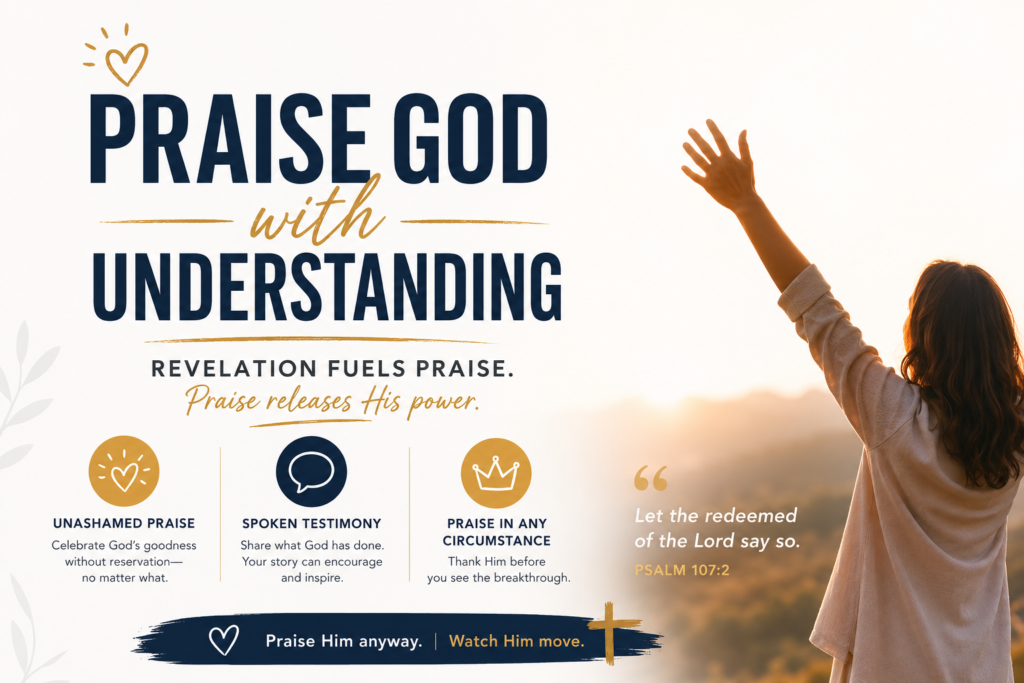
Understanding Praise and Worship
By Pastor Chinedu Emmanuel
Psalm 47:6–7 “Sing praises to God, sing praises; sing praises to our King, sing praises. For God is the King of all the earth; sing praises to Him with understanding.”
In many Christian circles, praising God has subtly slipped into an empty routine. It is easy to sit passively in church, listening to music or swaying to an organ without truly engaging in heartfelt praise. However, the Bible makes it clear that we are called to praise God with understanding. When praise is born out of revelation rather than mere emotional reaction or natural circumstance, it opens the door to God’s supernatural power.
What Is Praise?
Praise is the outward expression of our lips to show appreciation, love, and honor to God for all He has done. It means speaking about His greatness, boasting in Him rather than in ourselves, and declaring His power and salvation to others. To fully understand how God desires us to praise Him, we must look at the original Hebrew text, which uses distinct words to capture the full scope of praise.
Halal: Unashamed, Wild, and Spoken Praise
The first major Hebrew word for praise is Halal, which forms the root of Hallelujah. Halal carries two distinct, powerful meanings:
- Praise that doesn’t hold back: Halal means to make a joyful noise and celebrate God’s goodness without reservation. It is an unashamed, vibrant celebration, even if it appears foolish to the surrounding world. It prioritizes God’s glory above social expectations.
- Spoken Praise and Testimony: Halal is also spoken praise, unashamedly testifying about what God has done, particularly regarding salvation and transformed lives.
Scriptural Examples of Testimony:
- Mark 5:19: When Jesus delivered the demon-possessed man, He instructed him: “Go home to your friends, and tell them how great things the Lord has done for thee, and hath had compassion on thee.”
- Paul’s Example (1 Timothy 1:12–16): Paul openly shared how he had been a blasphemer and persecutor, demonstrating that God’s grace extends to the greatest of sinners.
- Psalm 107:2: “Let the redeemed of the Lord say so.”
While many wait for material or financial breakthroughs before sharing a testimony, the most powerful witness you possess is the story of your salvation and spiritual renewal.
Praising in the Face of Opposition: True Halal praise operates counter-intuitively to natural circumstances. It involves offering praise when outward situations appear difficult or challenging.
Context | Situation | Act of Praise |
Feeding the 5,000 (Luke 9:12–17) | Thousands were hungry in a remote location with only five loaves and two fish. | Jesus looked up to heaven and gave thanks before the miracle multiplied the food. |
Lazarus’s Tomb (John 11:39–41) | Martha noted that Lazarus had been dead for four days. | Jesus lifted His eyes to heaven and prayed, “Father, I thank thee that thou hast heard me,” prior to calling Lazarus forth. |
The Difference Between Natural and Supernatural Praise
A walk of faith is spiritually grounded and guided by the Holy Spirit. When praise relies entirely on external conditions such as musical accompaniment or church atmosphere, it remains fleshly and yields limited spiritual impact. In Acts 16, Paul and Silas were imprisoned without musical instruments or favorable circumstances, yet their praise connected directly to God, leading to supernatural deliverance. When you praise God through revelation, focusing on His character and promises rather than temporary obstacles, praise functions as a vital instrument of faith.
Actionable Steps for Daily Practice
- Share your salvation story: Openly recount how Christ transformed your life to encourage those around you.
- Praise through challenges: Choose to thank God for His faithfulness before seeing the physical resolution to your struggles.
- Engage deliberately: Shift from viewing praise as a passive routine during service to an active, intentional expression of thanks and appreciation for His wonderful works.
Pastor Chinedu Emmanuel is the Senior Pastor of Fountain of the Living Word Church in East Orange, New Jersey.